
 EN
Custom Pillowcase: Retail Sourcing Strategy
A custom pillowcase is a small bedding component with an outsized effect on assortment clarity. For an overseas retail buyer, the useful starting point is not a fabric label or a decorative print. The starting point is the role the item must play: a daily-use sleeping pillow cover, a coordinated bedding add-on, a seasonal accent, or a square decorative cover. From a B2B sourcing planner’s perspective, a custom pillowcase brief should connect that role to size, construction, care, presentation, quality control, and the market where it will be sold.
This approach also prevents a common mismatch. A decorative euro sham and a sleeping pillowcase may sit on the same bed display, but they can need different dimensions, closures, packaging, and replenishment logic. Build the brief first; compare quotations only after every supplier is working from the same requirements.
Start with the retail role of the custom pillowcase
Define the channel and shopper before selecting options. A custom pillowcase for a supermarket promotion may need a clear pack message and repeatable colorway. A home-textile collection may need coordinated styling across sheets, duvet covers, and cushions. An online retailer may need unambiguous dimensions, inclusion notes, care information, and product imagery that does not imply an insert is included when it is not.
- Core sleeping range: specify the target pillow size, finished cover tolerance, opening or closure, fabric, care-label requirements, and pack count.
- Decorative layer: state whether the custom pillowcase is a cushion cover or a euro sham, whether an insert is included, and the intended display use.
- Collection coordination: identify which colors, patterns, trims, or packaging elements must align with related bedding.
- Replacement or add-on sales: consider whether single units, pairs, or mixed packs make the item easier to merchandise.
For a buyer, the next question is simple: can a shopper understand what the custom pillowcase is for, what it fits, and what arrives in the pack? A broader range helps only when each option has a distinct role.
Choose material, function, size, and style in one brief
Material alone does not complete a custom pillowcase specification. Ask for the proposed composition, construction, finish, fabric weight or other approved fabric data, and the applicable care instruction. Then connect these inputs to the intended use. A daily-use cover may be evaluated differently from a decorative cover that is primarily chosen for texture, print, or room styling. Comfort impressions vary, so keep benefit language conditional and reserve performance claims for approved product evidence.
Size deserves the same discipline. Search references often describe a euro sham around 26 × 26 inches, or roughly 65 × 65 cm, but this is a market reference—not a substitute for the buyer’s approved insert and finished-cover measurement. For euro sham covers, confirm whether the quoted size refers to the insert, the finished cover, or the usable interior space. Also confirm seam allowance, flange dimensions, and whether the product is square after washing according to its approved care method.
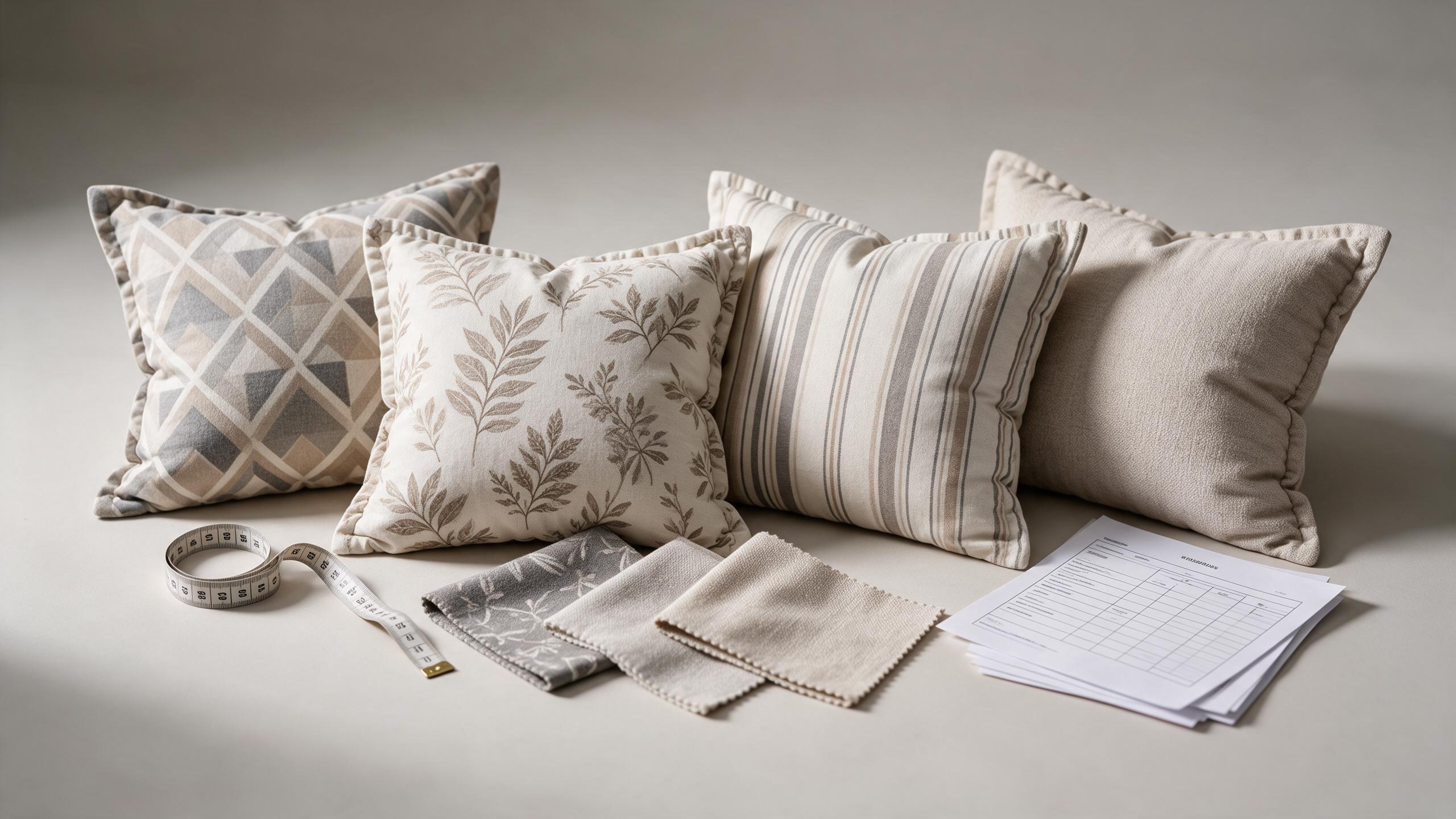
Style choices should follow the product role. A print, stripe, piping, flange, envelope back, zipper, or button closure can change both the visual brief and production control points. Rather than asking a supplier to make a custom pillowcase “similar to” an image, translate the image into measurable and checkable requirements.
Turn customization into an RFQ-ready specification
A custom pillowcase inquiry is more useful when it separates confirmed requirements from options that still need supplier confirmation. Use a specification sheet with the items below:
- Target market, sales channel, product role, planned launch window, and expected order mix.
- Pillow or insert dimensions, finished custom pillowcase dimensions, tolerances, and a clear measurement diagram.
- Fabric composition and construction requirements, subject to supplier confirmation and sample review.
- Closure, flange, trim, label, logo placement, artwork file format, color references, and packaging requirements.
- Requested sample stages: material or lab-dip review where relevant, pre-production sample, and approved production reference.
- MOQ by fabric, color, print, trim, packaging, and assortment combination; do not assume a category-wide MOQ.
- Quoted production lead time, inspection timing, shipping readiness date, and any dependencies on artwork or sample approval.
MOQ and lead time are not fixed properties of every custom pillowcase. They can change with fabric availability, print method, color count, construction complexity, packaging, order quantity, and the approval cycle. Request the supplier’s assumptions in writing so a bulk comparison is meaningful.
Build quality control into the custom pillowcase decision
Quality control begins before bulk production. First approve a measurement method and a sample that represents the intended construction. Then agree on the checks that matter for this item: dimensions, stitching, closure operation, trim placement, print or color alignment, label position, cleanliness, packaging count, and carton marks. For euro sham covers, check that the decorative flange and opening match the approved sample, not only that the outer square looks correct in a photograph.
A practical sequence is to record the approved sample, communicate the acceptance points, inspect early production where the program allows, and compare final goods with the approved reference before shipment. If a test, certification, color standard, or claim is important to the retail launch, name the document, scope, and acceptance condition in the brief instead of assuming it applies to every custom pillowcase.
Plan care and packaging before the purchase order
Care is part of selection, not a footer detail. Request the product-specific care instruction before finalizing the custom pillowcase, because washing, drying, ironing, and storage expectations may influence fabric choice, decorative elements, and customer communication. Do not copy generic care language across constructions without checking the approved label.
Packaging should likewise reflect the channel. Confirm unit folding, inserts or no-insert presentation, barcode location, polybag or other packaging requirements, set count, carton quantity, carton marks, and whether a euro sham needs a distinct product label from a sleeping pillowcase. These details can affect cost, timing, and receiving accuracy.
Compare bulk offers on matched criteria
For a fair custom pillowcase comparison, create one matrix for all shortlisted suppliers. Compare the same specification version, sample status, MOQ assumptions, unit and packaging scope, inspection plan, production timing, shipment terms, and documents requested. A lower quoted figure is not enough information if the custom pillowcase dimensions, closure, packing, or lead-time assumptions differ.
| Comparison area | Question to align |
|---|---|
| Product definition | Is this a sleeping pillowcase, cushion cover, or euro sham, and is an insert included? |
| Size | Are insert size, finished size, flange, and tolerance stated in the same unit? |
| Customization | Which artwork, trims, labels, and packaging features are included in the quotation? |
| Quality control | Which approved sample and acceptance points will be used for inspection? |
| Timing | What events start the lead-time clock, and what must be approved first? |
Use product references carefully and move to the next check
For visual direction, review relevant site references such as 20x20 Boho Pillow Covers – Timeless Striped Charm for Every Space and Honeymoon Hot Sale 3d Trendy Sofa Decorative Kids Home Pillowcase Cushions Covers for Bedroom. Treat these as product references only; confirm the exact material, construction, dimensions, packaging, and available customization scope for the order at hand.
The sourcing routine can stay practical: define the retail role, measure before naming a size, compare like with like, approve a reference sample, and make care, quality control, MOQ, and timing visible in the purchase brief. A well-scoped custom pillowcase program gives the retail team a clearer assortment story and gives suppliers a more actionable basis for quotation and production confirmation.