
 EN
Microfiber Duvet Cover: Material Comparison Guide
A microfiber duvet cover does more than sit on top of bedding. For an importer, retailer, or hotel buyer, it becomes a specification exercise: hand feel, construction, insert fit, wash routine, visual range, and consistency at scale all matter. As a B2B sourcing planner, I would start a microfiber duvet cover brief with the end use and selling channel, then compare like with like before requesting prices.
The useful shift is from asking whether a microfiber duvet cover feels soft to asking: soft for whom, with which duvet insert, in what climate, and under what laundry routine? A material name alone does not answer those questions. Fabric weight, weave or brushed finish, closure, corner ties, dimensions, and packaging can all change the final offer.
Start With the Buying Brief, Not the Fabric Label
Before comparing a microfiber duvet cover with cotton or linen, document the intended bed sizes, expected set components, target price band, color direction, and care instructions. A cover-only SKU and a set containing shams are different offers; neither should be assumed to include a duvet insert. Your RFQ should state the component list plainly.
For a duvet 240x240 request, record whether 240 x 240 cm refers to the cover’s finished dimensions, the insert dimensions, or the nominal bed-program label. Measure the insert after loft and allow the supplier to state its finished-size tolerance. It may read like a technical detail, but it avoids a familiar sourcing error: a microfiber duvet cover can be well made yet unsuitable if it does not fit the selected insert as intended.
How a Microfiber Duvet Cover Compares With Other Materials
| Material route | Where it may fit | What to confirm before ordering |
|---|---|---|
| Microfiber duvet cover | Programs prioritizing a smooth hand, easy-care positioning, broad color options, or a lightweight cover. | Fiber content, finish, fabric construction, opacity, pilling expectations, closure, and wash instructions. |
| Cotton cover | Programs where natural-fiber positioning and airflow are priority considerations. | Fiber specification, weave, prewash treatment, shrinkage expectation, and care label. |
| Linen or linen-blend cover | Textured, relaxed visual programs where visible creasing is part of the intended look. | Blend composition, texture consistency, color variation, and the care message for the retail market. |
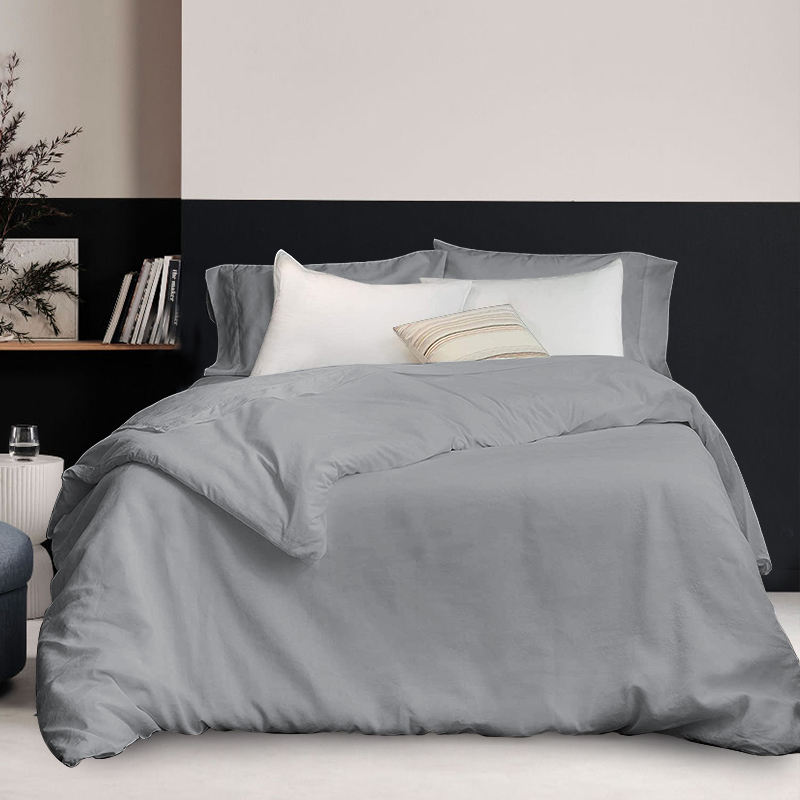
Search results commonly associate a microfiber duvet cover with smoothness, lighter handling, and straightforward laundering, while cotton is often discussed in relation to breathability. Treat those as comparison directions, not universal performance promises. A lightweight label does not establish cooling, and a brushed finish may alter the hand and care experience. The specification to confirm is the actual fabric and finish used for the sampled microfiber duvet cover.
Fit the Cover to the Duvet Insert
A duvet insert supplies insulation; a microfiber duvet cover protects it and changes the bed’s visual and tactile presentation. The cover should be reviewed with the intended insert, not as a flat fabric sample alone. Ask for the closure type, number and placement of internal ties, opening width, corner construction, and whether the insert shifts during normal handling.
For duvet 240x240, put a dimension chart into the purchase order. Include finished cover length and width, insert length and width, allowed tolerance, measurement method, and the point in production when measurement occurs. If your assortment crosses markets, do not translate king, super king, or double labels without the metric dimensions. A microfiber duvet cover decision often changes once it is viewed alongside the insert, pillowcases, fitted sheets, and the bed-size program.
Specify Construction and Style Separately
Buyers should separate the style brief from the performance brief for each microfiber duvet cover. The style brief can cover solid colors, crinkle texture, print scale, reversible treatment, or coordinated pillowcases. The performance brief should cover fabric composition, fabric weight if required, seams, closure, corner ties, label content, carton marks, and the care label. This separation helps a supplier quote the same microfiber duvet cover concept across several market-ready designs without confusing appearance with an unconfirmed functional claim.
For example, the CMS-confirmed microfiber crinkle solid duvet cover sets can be used as a starting point for a style conversation. Confirm its current component list, dimensions, fabric details, and commercial terms directly in the RFQ rather than inferring those details from the product name. If a filled bedding option is also relevant, review the CMS-confirmed microfiber comforter and duvet listing separately: it is a different product category from a cover and should not substitute for a specified duvet insert.
Quality Checks for a Microfiber Duvet Cover Order
A repeatable inspection plan is more useful than a broad quality claim. Review the approved sample, then make the production checks observable for every microfiber duvet cover order:
- Verify fabric appearance, shade, print placement, and hand against the approved sample under agreed viewing conditions.
- Measure finished dimensions for each duvet 240x240 size and record the agreed tolerance.
- Check seam continuity, loose threads, closure operation, and the count and attachment of corner ties.
- Confirm the actual component count, because a cover set and a duvet insert program are not interchangeable.
- Review care label, fiber-content statement, barcode, polybag, insert card, and outer-carton requirements before bulk packing.
If you require colorfastness, shrinkage, pilling, or chemical-compliance evidence, define the applicable market, test method, threshold, laboratory, and document format in the RFQ. Do not assume a microfiber duvet cover carries a particular certification or test result unless the supplier provides current evidence for the relevant SKU.
MOQ, Lead Time, and Sampling Questions
MOQ and lead time are commercial inputs, not material facts that can be inferred from a microfiber duvet cover description. Ask the supplier to quote a sample route, bulk MOQ by color and size, packaging MOQ, artwork timing, raw-material booking point, preproduction approval point, inspection window, and shipment-ready date. Then compare quotes only after construction, duvet 240x240 dimensions, component list, and packaging are aligned.
Care planning belongs in the same conversation. Ask how the proposed microfiber duvet cover should be washed, dried, ironed if applicable, and stored; then make sure the care label uses the approved market language and symbols. A realistic order plan accounts for sample approval and labeling review before a bulk date is committed.
A Practical Comparison Checklist
- Define whether the offer is cover-only, a cover set, or includes a duvet insert.
- Lock dimensions in centimeters, especially for duvet 240x240, and state how fit will be evaluated.
- Compare each microfiber duvet cover material and finish against the same care, style, and channel requirements.
- Approve a sample and convert its construction, labels, packing, and inspection points into the purchase order.
- Request current MOQ, lead-time, test, and compliance information for the exact SKU rather than relying on category-level assumptions.
The right microfiber duvet cover is the one whose fabric, fit, components, care instructions, and order controls suit the program you are building. Start with a complete brief, verify the sample, and keep the cover and duvet insert specifications distinct. That approach makes comparisons clearer for both the sourcing team and the supplier.