
 EN
King Size Coverlet Size: MOQ Planning Guide
For an overseas buyer, king size coverlet size is not a label to copy from a catalogue. It is a specification that affects visual coverage, cutting yield, packing, MOQ planning, sample approval, and the risk of a costly size mismatch. As a B2B sourcing planner, I start with the intended market, mattress dimensions, and required drop before comparing fabric or decoration.
A king size coverlet size brief should name the finished width and length, the measurement tolerance, the target bed, and where the coverlet should finish on each side and at the foot. That approach is more dependable than assuming that “king” carries the same meaning in every sales market.
Start with the bed, not the king label
In the US market, a standard king mattress is commonly listed as 76 × 80 inches, whereas a California king is commonly listed as 72 × 84 inches. Those figures are useful starting points, not global rules: UK, European, hospitality, and custom bed formats can differ. A king size coverlet size intended for a US king may therefore be unsuitable for a California king or another regional king format.
Use this working calculation before requesting a quote:
finished coverlet width = mattress width + left drop + right drop
finished coverlet length = mattress length + foot drop + head allowance
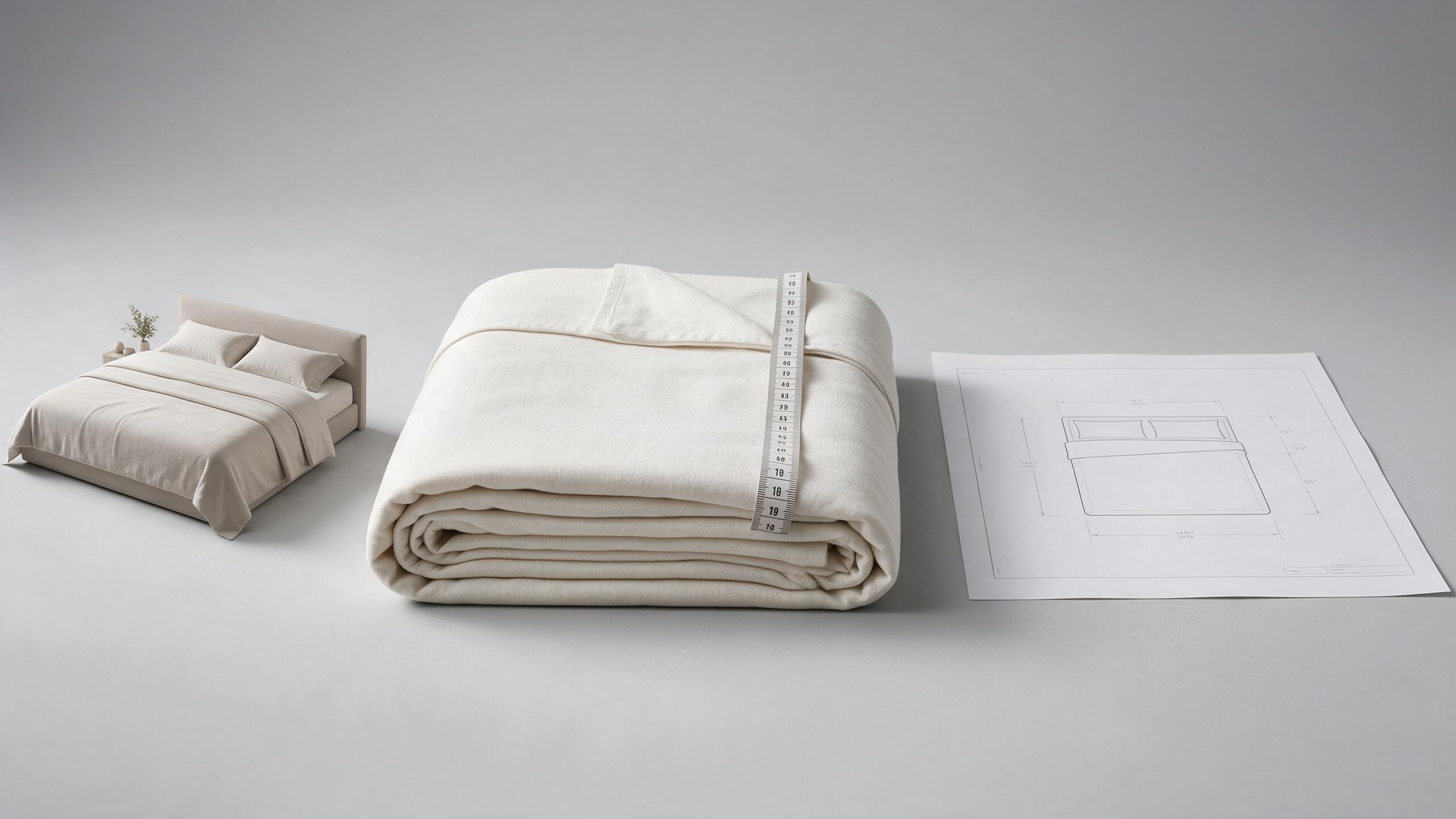
For example, a buyer can begin with a 76 × 80 inch mattress, then define whether the coverlet should stop at the mattress edge, cover the side rails, or create a deeper drape. This is why a king size coverlet size can vary substantially across retail collections. Search results show illustrative king quilt dimensions such as 108 × 95 and 112 × 94 inches; treat those as examples of different presentation choices, not as a universal standard.
Choose the right king size coverlet size for the use case
| Use case | What the buyer should define | Why it changes the specification |
|---|---|---|
| Retail king bedspread | Mattress market, desired side drop, display styling | A king bedspread may be designed for a tailored look or a deeper visual drop. |
| Layering piece | Whether it sits over a duvet and pillows | A king size coverlet size used as a top layer may need different length and width allowances. |
| Hospitality or project bedding | Bed base, tuck requirement, laundering routine | Operational fit and replacement consistency can matter as much as appearance. |
| Luxury bedding sets king range | Included components, color story, packaging concept | The coverlet must be sized and labelled clearly alongside shams or other components. |
Before comparing materials, ask one simple question: what should the finished king size coverlet size look like on the made bed? That sounds visual, but it turns into measurable instructions for width, length, quilting layout, pattern placement, and carton dimensions.
Material, construction, and style decisions
A coverlet can be selected for a light decorative layer, for coordination with bedding, or for a collection that changes with season and channel. Cotton, microfiber, linen-look, and blended constructions can lead to different hand feel, care requirements, weight, and cost structure. The material name alone is not a full specification. For any king size coverlet size, request the composition, fabric construction, filling status where relevant, quilting method, finished dimensions, and care-label wording as separate fields.
Style also changes the planning discussion. A geometric quilted design, a solid coverlet, and a patterned king bedspread can have different concerns around panel layout, print alignment, or shrinkage allowance. Rather than assume a result, ask the supplier to show how the selected construction is measured after finishing and how the tolerance is checked.
Turn king size coverlet size into an MOQ-ready brief
MOQ should be discussed after the buyer fixes the specification, not before. A single king size coverlet size in one fabric, color, pattern, and pack format may have a different production setup from an assortment with several sizes and coordinated items. For luxury bedding sets king, clarify whether the MOQ applies per color, per design, per size, per set configuration, or across the combined order.
- Size sheet: finished width × length, target market, desired drop, and tolerance.
- Construction sheet: shell material, backing, quilting or stitch description, edge finish, and any fill requirement to confirm.
- Assortment sheet: king bedspread or coverlet, matching items, colors, and component count.
- Packaging sheet: fold method, insert card, label language, barcode needs, carton count, and shipping marks.
- Commercial sheet: sample route, MOQ basis, target order split, requested production window, and destination market.
This level of detail makes a king size coverlet size request easier to compare like for like. It also lets a buyer distinguish confirmed requirements from options still needing supplier confirmation.
Use confirmed on-site product pages as a discussion starting point
Two internal catalogue pages can help a buyer frame the product category without assuming unlisted specifications. Review the king quilt set product page when considering a coordinated king presentation, and the wholesale quilt bedspread and coverlet collection when defining the category. Then request the current specification sheet for the exact king size coverlet size, because a listing title is not a substitute for confirmed dimensions, composition, components, or MOQ.
Sample approval and quality acceptance checkpoints
Measure the sample on a flat table and, where possible, on the intended bed format. Record the actual king size coverlet size after finishing, side-to-side consistency, length, corner shape, edge treatment, stitch appearance, label placement, and packaging count. Put the accepted measurement method into the purchase order. A photo alone cannot establish whether a king size coverlet size meets the agreed tolerance.
For a bulk order, retain an approved reference sample and specify the inspection checkpoints: finished size, visible construction, shade or print against the approved standard, loose threads, label information, pack contents, carton markings, and quantity reconciliation. If a care claim or performance statement is important, request documentation that covers the exact product and market rather than carrying wording forward from another item.
Care, lead time, and comparison checklist
Care is part of selection, not an afterthought. The intended wash and drying routine can affect fabric choice, construction, label instructions, and the buyer’s allowance for dimensional change. Ask for the care label during sampling, then ensure the same requirement appears in the bulk-order specification.
Lead time is also specification-dependent. Instead of relying on a general estimate, ask what dates apply after artwork approval, material confirmation, sample sign-off, packaging approval, and deposit or purchase-order milestones. The more variants a luxury bedding sets king range includes, the more useful it is to map these approvals before fixing the delivery plan.
- Confirm the market-specific mattress dimensions.
- Define the intended drop and calculate the finished king size coverlet size.
- Separate coverlet dimensions from the dimensions of every included item.
- Approve a measured sample, tolerance, care label, and pack configuration.
- Compare MOQ, production assumptions, inspection points, and shipment timing on the same brief.
The practical conclusion is straightforward: a king size coverlet size is a buying decision, not merely a product label. When width, length, drop, construction, packaging, and acceptance criteria are written into one brief, a buyer can plan MOQ and evaluate options with far fewer assumptions.