
 EN
Quilted Coverlet: Supplier Evaluation Guide
A quilted coverlet can look like a straightforward bedding item, yet an overseas buyer usually has to reconcile three different briefs: the retail look, the sleeping or display use, and the specification a supplier can actually confirm. A coverlet normally sits over the bed as a lighter top layer; depending on the market, it may be used alone, layered with other bedding, or merchandised as a coordinated set. Start with that role rather than a fabric label alone.
From a B2B sourcing planner’s perspective, the useful question is not “Which quilted coverlet is right?” but “Which specification can be sampled, inspected, packed, and replenished for this channel?” That sounds technical, but it protects the buying brief from assumptions about size, loft, hand feel, included pieces, or care.
1. Define the coverlet’s job before comparing suppliers
Write down the intended channel first: online retail, a department-store range, hospitality, a seasonal promotion, or a private-label collection. Then state whether the quilted coverlet is a standalone bed layer, a decorative top layer, or part of a bedding set. The same visual style may need different dimensions, packaging, labeling, and replenishment planning in each setting.
- Target market: use actual mattress and bed measurements, not only local labels such as queen or king.
- Assortment role: decide whether it is an entry, core, or coordinated item, and which colors or patterns must work with the rest of the range.
- Use conditions: identify whether shoppers are likely to prioritize layering, easy bed-making, frequent laundering, or display presentation.
- Included components: request a written list; do not infer shams, sheets, or filling from product imagery.
A white coverlet may be useful for a clean, adaptable assortment, for example, but the commercial brief still needs a defined size, construction, pack quantity, labeling language, and care requirement.
2. Compare construction and material as separate choices
Quilting describes a construction approach; it is not, by itself, proof of warmth, durability, or a particular feel. Ask suppliers to describe the face fabric, reverse fabric, filling if any, quilting pattern, stitch density or construction detail, edge finish, and finished dimensions. Treat every item as a matched specification exercise. Comparing two quilted coverlet samples is meaningful only when the dimensions, layers, and care instructions are aligned.
Material names also need context. A buyer may compare cotton, microfiber, blends, or other approved options, but composition is only one input. Construction, fabric weight, finishing, shrinkage allowance, color consistency, and care instructions can alter the practical result. Rather than asking a supplier for a broad performance promise, ask for the current specification sheet and the corresponding sample.
For visual references within an existing range, review the site’s wholesale bedding set coverlets and the modern quilt set. Use these pages to open a specification conversation; their titles and images should not replace a product-specific confirmation.
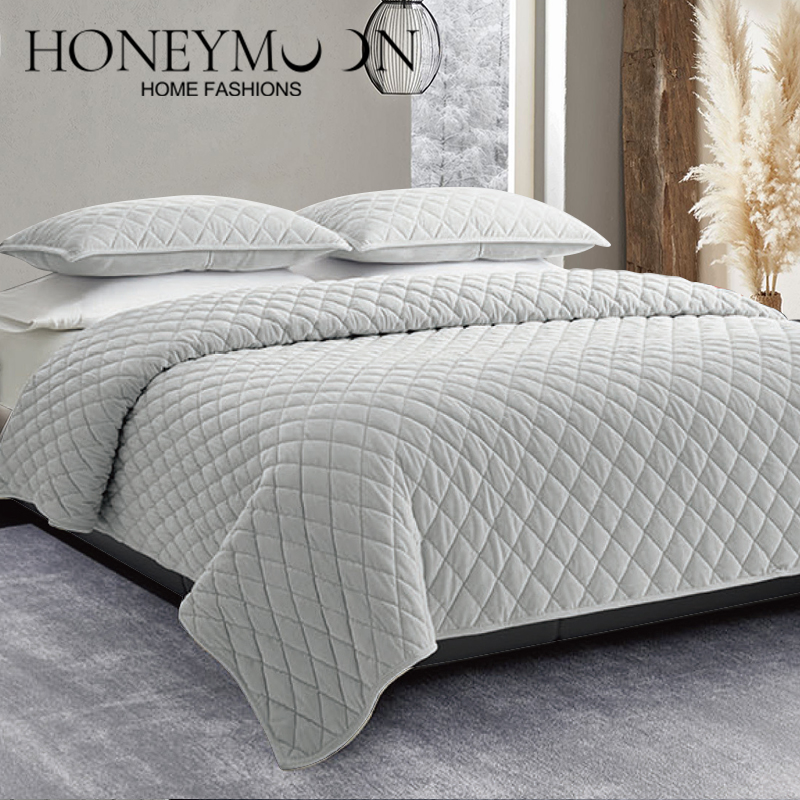
3. Put size and style into a measurable buying brief
Coverlet dimensions need more than a bed-size label. Confirm mattress width and length, desired side drop, pillow treatment, and whether the product should cover a box spring or stop above it. A white quilted bedspread is often searched as a style term, but a bedspread and a coverlet can have different intended drops. Ask the supplier to provide finished measurements with permitted tolerances and to label the target-market size clearly.
For design review, approve a color reference, quilting layout, trim or binding, placement of labels, and any pattern repeat before bulk production. If a private-label request involves changes, distinguish confirmed options from items that still require a development review. That separation keeps the quilted coverlet brief usable when teams compare quotations.
4. Turn samples into quality-acceptance checkpoints
Sampling should test the agreed product, not a loosely similar substitute. Retain an approved sample or signed specification sheet, then make the bulk inspection points visible: finished dimensions, construction appearance, seams and binding, loose threads, fabric defects, color consistency, packing, barcodes, and care-label content. For laundering-related concerns, agree the applicable test method and acceptance threshold in the quality agreement. AATCC and ASTM methods can be reference points, but the buyer and supplier must confirm which method applies and what result is acceptable for the exact quilted coverlet.
Care is another procurement input, not an afterthought. Ask for the product-specific care label before approving copy or packaging. A gentle routine may be appropriate for some constructions, but it should not be presented as a universal instruction. The buyer should check wash temperature, detergent restrictions, drying method, and any warnings against the approved item.
5. Compare MOQ, customization, and lead time without assumptions
Before comparing cost, align the same commercial assumptions: MOQ by color and size, sample fees and revision path, fabric availability, customization scope, packing format, inspection timing, and shipping-ready date. A supplier may be able to discuss options, but capacity, lead time, and development feasibility should be confirmed in writing for the selected specification. One option may simplify assortment coordination while another may create more variation; neither is automatically right for every buyer.
| Supplier question | Why it matters | Evidence to request |
|---|---|---|
| What is the MOQ by SKU, color, and size? | Prevents a blended MOQ assumption. | Quotation with SKU breakdown. |
| Which design details can change? | Separates an approved option from a development request. | Marked specification and sample plan. |
| What is the production sequence? | Clarifies dependencies without treating a date as fixed. | Written timeline tied to approvals and materials. |
| How will bulk quality be checked? | Creates an agreed inspection path. | Inspection checklist and acceptance criteria. |
7. Supplier comparison matrix for a quilted coverlet brief
Use this short matrix when several teams are reviewing a quilted coverlet range. Each line converts a visual preference into a supplier question, so the final quilted coverlet comparison is based on the same evidence.
- For a quilted coverlet, confirm finished width, length, and allowed tolerance.
- For a quilted coverlet, request face, reverse, and filling details separately.
- For a quilted coverlet, approve the quilting layout and edge finish on the sample.
- For a quilted coverlet, record whether shams or other pieces are included.
- For a quilted coverlet, align carton marking, inner packing, and retailer labeling.
- For a quilted coverlet, ask how bulk fabric shade will be controlled.
- For a quilted coverlet, review the product-specific care label before packaging approval.
- For a quilted coverlet, set the inspection point and retain-sample procedure.
- For a quilted coverlet, list MOQ by approved color, size, and pack configuration.
- For a quilted coverlet, connect production timing to material and sample approvals.
- For a white coverlet, confirm the approved color reference under the intended review conditions.
- For a white coverlet, decide which coordinated colors belong in the same assortment.
- For a white coverlet, verify that the label distinguishes style terms from finished dimensions.
- For a white coverlet, compare surface construction, care requirements, and pack presentation.
- For a white quilted bedspread, confirm the desired side drop rather than relying on the name.
- For a white quilted bedspread, approve pattern placement and binding at sample stage.
- For a white quilted bedspread, request a written component list for the exact SKU.
- For a white quilted bedspread, keep quality acceptance criteria with the purchase record.
- For a white quilted bedspread, compare MOQ and timing using the same specification assumptions.
This format makes a quilted coverlet request easier to quote, sample, inspect, and replenish. It also makes a white coverlet or white quilted bedspread decision traceable when several suppliers offer similar-looking items.
6. A practical shortlist checklist
- Match the quilted coverlet role to the channel and actual bed dimensions.
- Compare samples against the same construction, material, finished-size, and care criteria.
- Confirm every included component and every visible design detail in writing.
- Approve a quality checklist, test-method references where relevant, and a retain-sample process.
- Request MOQ, quotation scope, packing, and production assumptions by SKU rather than as a general statement.
- Review the care label and target-market terminology before finalizing product copy.
A well-scoped quilted coverlet request gives a supplier a clearer way to respond and gives the buyer a defensible comparison record. HENIEMO’s home-textile context can support buyer conversations around bedding and coordinated collections; for a purchase decision, use this guide alongside the current product specification, sample review, and written supplier confirmation.