
 EN
Velvet Quilt: Size Selection Guide
A velvet quilt can give a bedding assortment a richly textured, decorative layer, but an overseas buyer should not start with color or a regional size label. Start with the bed dimensions, intended coverage, construction, care expectations, and the role the item will play in the range. It is a lot to put in one brief. Still, the practical question is simple: will this velvet quilt fit the intended bed, suit the channel brief, and arrive with the information needed for approval?
For a retailer, supermarket buyer, or sourcing team, a velvet quilt is often evaluated alongside a quilt comforter, a coverlet, and coordinated bedding. Those names can overlap in everyday use, so the purchase order needs measurements and component details rather than assumptions. HENIEMO’s home-textile context is oriented toward global buyers; use that context to make the brief more precise, not to assume a specification that has not been confirmed.
Define the role of the velvet quilt before choosing a size
First, state what the velvet quilt is expected to do in the collection. Is it a lightweight top layer, a decorative coverlet, a quilt comforter intended to be the main visual bedding piece, or part of a multi-piece set? The answer changes the coverage you need. A decorative layer may sit nearer the mattress edge, while a retail-facing bed display may need more side drop and a coordinated sham plan.
Next, separate a material description from a full specification. “Velvet” may describe the face fabric or the intended visual effect; it does not by itself confirm fiber content, backing, fill, quilting pattern, weight, care method, or included pieces. Ask the supplier to identify those fields for the selected velvet quilt sample. This avoids comparing two products that share a category name but serve different use cases.
Measure first, then map the velvet quilt size
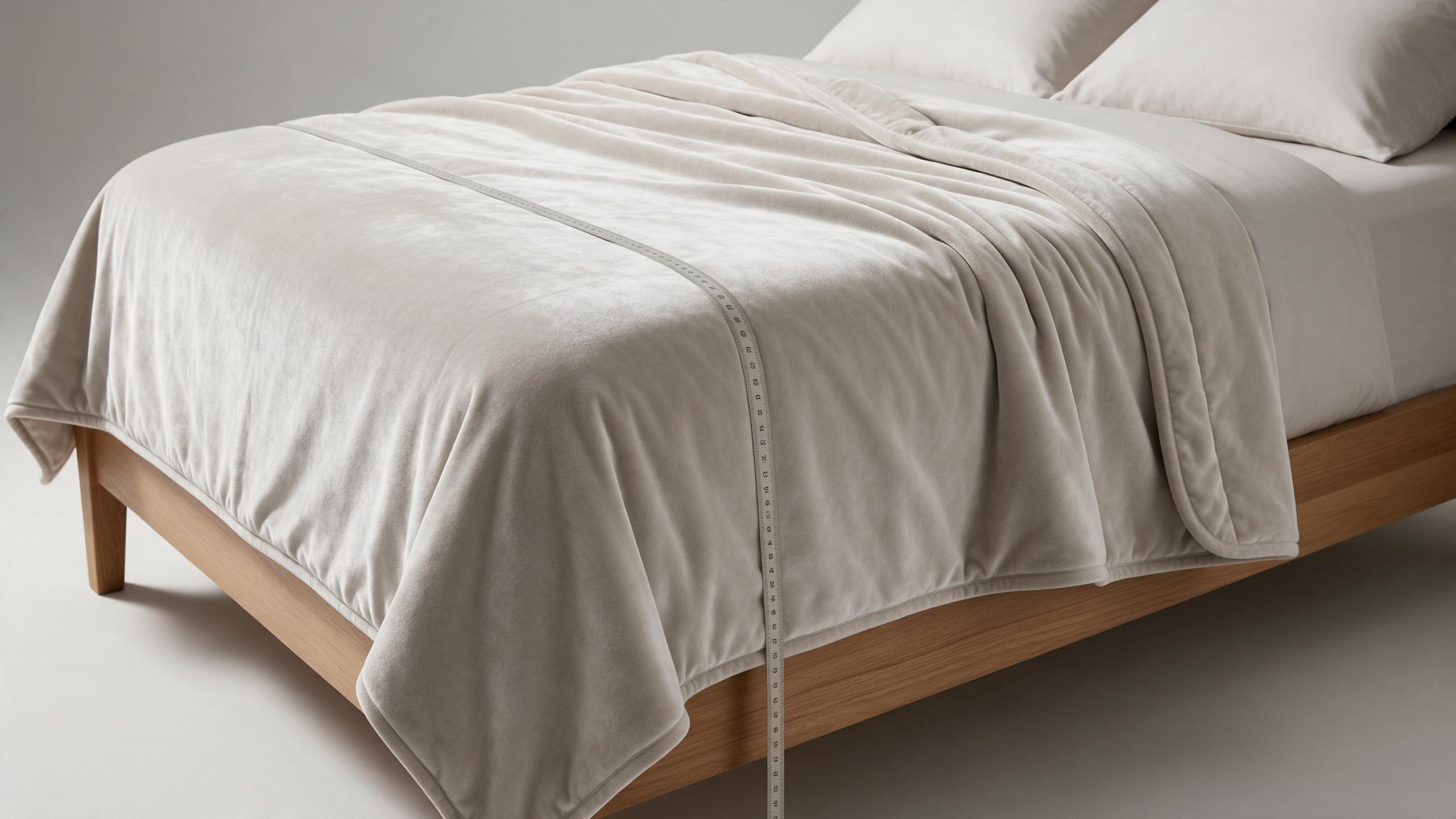
A frequent avoidable mistake is assuming that queen, king, double, or full means the same dimensions in every target market. Build the velvet quilt brief around actual measurements in both centimeters and inches where needed. Record mattress width and length, then decide how far the finished item should extend beyond each side and at the foot of the bed.
| Brief input | Why it matters | Buyer action |
|---|---|---|
| Mattress width and length | Provides the base footprint for the velvet quilt. | Use measured dimensions, not only the bed-size name. |
| Desired side drop | Changes the finished width and display coverage. | Specify the visible drop separately for each target market. |
| Foot-end coverage | Determines whether the velvet quilt ends flush, folds over, or drapes. | Approve on a made bed or an annotated sample photo. |
| Pillow and sham plan | Clarifies whether the set includes decorative components. | List each component and its dimensions in the PO. |
A useful formula is: finished width = mattress width + left drop + right drop; finished length = mattress length + desired foot coverage + any head-end allowance. Think of the formula as a way to frame the conversation, not as a universal product measurement. Before confirming a velvet quilt, have the supplier validate the proposed finished dimensions against the intended construction and packing method.
Compare a velvet quilt and quilt comforter on matched criteria
Do not treat a velvet quilt and a quilt comforter as interchangeable simply because a listing uses both terms. Compare like for like: face and backing materials, fill or layer structure, finished dimensions, quilting method, included components, intended visual coverage, and approved care instructions. One option may simplify a coordinated display, while another may make replacement planning easier; neither is automatically the right choice for every buyer.
For an internal review, the two confirmed catalog records are useful starting points: HENIEMO’s flannel fleece comforter and quilt sets and HENIEMO’s microfiber comforter, summer quilt, bedspread, and coverlets. Use the live product pages to request current specifications; their titles do not establish the exact composition, dimensions, or performance of the item you plan to buy.
A green comforter can be a useful assortment reference when color is central to a program, yet a color brief should be separated from the size brief. Specify the approved color standard, visible face placement, reverse-side expectation, trim, stitching, and packaging presentation independently of the velvet quilt dimensions.
Turn the size brief into a supplier-ready specification
Once the size is selected, turn the velvet quilt decision into a document a factory can quote and a quality team can inspect. The early sourcing question is often not price but whether the brief states material, dimensions, packing, market, and approval checkpoints.
- Target market, channel, and planned product name.
- Finished velvet quilt width, length, permitted measurement tolerance, and desired bed coverage.
- Face, reverse, fill or layer construction to be confirmed on the approved specification sheet.
- Quilting layout, edge treatment, labels, component list, and color approval method.
- Sample route, MOQ discussion, proposed production lead time, packing requirements, and shipping-ready date.
Customization, MOQ, and lead time should be handled as quote-stage questions. Ask what changes would affect the minimum order, sampling sequence, material availability, calendar, and packing. This keeps the velvet quilt brief commercially useful without presenting unconfirmed service terms as facts.
Build quality acceptance around what can be checked
For a velvet quilt, quality acceptance is clearer when the inspection list follows the purchase order. Check finished dimensions after the agreed measuring method; verify count and placement of included pieces; compare color and surface appearance with the approved sample; review seams, quilting alignment, edge finish, labels, and packing. If the product has a reversible face or printed elements, define which side is the approval reference.
Care language also belongs in pre-production review. General textile-care guidance distinguishes washing and drying methods and calls for warnings when an expected process could cause harm. For each velvet quilt, request the product-specific approved care instruction and verify that it matches the selected construction. Do not publish generic machine-wash, tumble-dry, colorfastness, or durability claims unless the applicable product evidence supports them.
Care, assortment, and bulk-buying checklist
Care planning affects the assortment after the sale as well as the initial purchase. Confirm how the proposed velvet quilt should be cleaned, dried, stored, and displayed before you finalize the channel plan. A buyer choosing a quilt comforter for a frequent-laundry setting may prioritize different evidence than a buyer building a decorative seasonal display.
- Measure the actual bed and define the desired side and foot coverage.
- Confirm whether the velvet quilt, quilt comforter, shams, or other pieces are included.
- Approve the material and construction specification instead of relying on category wording.
- Request a sample or documented approval route before bulk production.
- Agree on measurement, appearance, labeling, and packing checkpoints for inspection.
- Ask for MOQ, lead-time, and delivery assumptions in the current quotation.
- Review the final care instruction for the exact approved product.
The right velvet quilt size is therefore not just a label such as king or queen. It is a documented relationship between the mattress, desired coverage, components, construction, care route, and buying plan. When those inputs are clear, a sourcing team can compare options with fewer assumptions and send a more actionable inquiry to HENIEMO.