
 EN
Lightweight Bedspreads: Commercial Use Guide
For an overseas buyer, lightweight bedspreads are not simply a warm-weather item. They can occupy a clear role in a retail collection, guest-room program, or online assortment: an upper layer that gives the bed a finished appearance without assuming the role of a filled comforter. As a B2B sourcing planner, I would begin with the sales channel, bed dimensions, and care routine—not with a fabric label alone. That sequence makes lightweight bedspreads easier to compare and easier to brief to a supplier.
The useful shift is from asking whether a bedspread is light to asking light for which customer, climate, bed size, and laundering routine? A coverlet intended for a display-led retail range may be specified differently from one planned for a guest-room refresh. In either case, the buying brief needs dimensions, construction, composition, included pieces, packing expectations, and the acceptance points that will be checked on a sample and at bulk inspection.
Where lightweight bedspreads fit in a commercial assortment
Lightweight bedspreads commonly suit layered-bed presentations, transitional seasons, warm rooms, guest accommodation, and shoppers who want a less bulky top layer. Their role should be stated plainly in the assortment: decorative top layer, coverlet, quilted bedspread, or part of a coordinated set. This avoids a frequent sourcing problem—using “bedspread,” “quilt,” and “coverlet” as interchangeable descriptions of construction or included components.
For retail, lightweight bedspreads can create an accessible core offer alongside heavier comforter sets or throws. For hospitality or rental use, the decision usually depends on how the item will be made up, washed, stored, and replaced. Before selection, define whether pillow shams are required, whether the item must drape over the mattress edge, and whether the product will be presented folded or fully spread. Those questions turn a broad category into a usable specification.
Start with the use case, then choose the coverlet specification
Material is one input, not a substitute for a full product description. When comparing lightweight bedspreads, ask for the fiber composition, fabric construction, quilting or non-quilted construction, filling status where relevant, surface finish, and care-label guidance. Cotton, microfiber, blended fabrics, and textured constructions can each be considered, but the practical fit depends on the approved specification and intended use conditions.
It may seem like fabric is the whole story—actually, dimensions, construction, and care can be just as decisive. A buyer considering faux fur bedding should treat it as a distinct visual and care proposition rather than as a substitute for a conventional light coverlet. Likewise, fleece bedding may be relevant to a cozy seasonal collection, but it needs its own hand-feel, care, and market-positioning review. Neither auxiliary category should be assumed to satisfy a lightweight brief without checking its actual construction.
Use a comparison matrix for lightweight bedspreads
| Decision point | What to define in the brief | Why it matters |
|---|---|---|
| Product role | Coverlet, bedspread, quilted top layer, or coordinated set | Keeps included pieces and shopper expectations clear. |
| Size | Finished width and length in cm or inches, plus target bed size | Regional labels alone may not establish fit or drape. |
| Construction | Fabric, layer arrangement, stitching pattern, edging, and closure details if applicable | Allows like-for-like comparison among lightweight bedspreads. |
| Care | Approved wash, dry, and storage instructions | Connects the selection to recurring use rather than appearance only. |
| Presentation | Folded, packaged, or bed-made display requirements | Helps align packing and merchandising expectations. |
This matrix is also a practical way to compare lightweight bedspreads across suppliers. First confirm dimensions, then compare construction and care, and only after that assess pattern, color, or other decorative choices. A pattern worth watching is that comparisons become less useful when buyers align only the product name and not the underlying requirements.
Size, style, and collection coordination
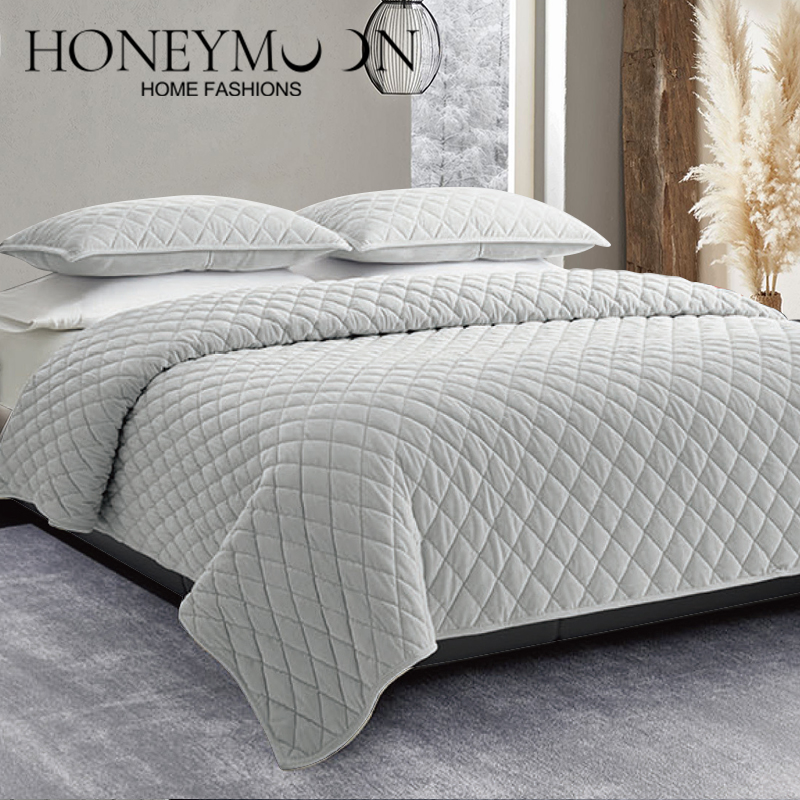
For lightweight bedspreads, ask for finished measurements rather than relying only on labels such as queen or king. A commercial brief should record the target market, mattress size, preferred drop, and whether the product is meant to cover pillows or sit below them. If the product is sold with shams, define the piece count and dimensions separately. The better fit depends on the intended bed presentation, so confirm these details before a sample is approved.
Style should support the range role. Solid colors, stitched textures, prints, and reversible looks can each be considered, but the article’s sourcing point is simpler: choose a style direction after the base specification is stable. A decorative collection that includes faux fur bedding or fleece bedding may need separate seasonal messaging and care verification, while neutral lightweight bedspreads can be positioned as a coordinating layer if the approved product data supports that placement.
Use matched products as starting points, not assumed specifications
HENIEMO’s catalog provides two relevant internal product references for buyers researching this category. The Honeymoon wholesale quilt bedspread and coverlets page can be used to begin a category conversation around quilt-bedspread and coverlet terminology. The custom modern king quilt set page offers a second internal reference for collection planning.
These links are starting points for an inquiry, not proof of every option a buyer may need. For lightweight bedspreads, request the current item-level sheet before treating material, size, customization, MOQ, packaging, or lead time as confirmed. That boundary is important: a product title signals a category, while the commercial decision requires an approved specification.
MOQ, sampling, quality acceptance, and lead-time questions
The first sourcing question is often not price but whether the brief specifies material, dimensions, packing, market, and required confirmation. A useful inquiry for lightweight bedspreads should include the expected order quantity, color or pattern direction, target size range, whether shams are included, labeling needs, and destination market. Separate confirmed requirements from options that still need supplier confirmation.
- MOQ: Ask for the applicable MOQ by construction, colorway, size, and packaging configuration. Do not assume one MOQ covers every variation.
- Sample review: Measure finished dimensions, confirm visual construction, inspect stitching and edging, review the included-piece list, and check that care information matches the proposed item.
- Bulk acceptance: Agree in writing which measurements, visual checkpoints, packing details, labels, and allowable variations will be reviewed before production release.
- Lead time: Request a current production and shipping schedule for the exact scope. Timing can change with material availability, development work, order complexity, and destination arrangements.
For a buyer, the next question is simple: can the supplier restate the brief for the selected lightweight bedspreads in a way that can be checked? If not, refine the RFQ before comparing quotations. Clear documentation is more useful than a vague promise, especially when multiple sizes, colors, or packing formats are under consideration.
Care and bulk-purchase comparison checklist
Care belongs in the buying decision, not only in post-purchase instructions. Ask how the proposed lightweight bedspreads should be washed, dried, stored, and relabeled for the target channel; then verify that the guidance is item-specific. This is especially relevant when a range includes texture-focused alternatives such as faux fur bedding or fleece bedding, because the desired presentation and care routine may differ from a conventional coverlet.
- Define the commercial role and target channel.
- Confirm finished dimensions and included components.
- Compare materials and construction using the same criteria.
- Review sample measurements, visual quality, care information, and packing.
- Confirm MOQ and lead time for the exact order scope.
- Document bulk acceptance checkpoints before release.
Strong supplier content leaves buyers with what to ask, measure, and document next. For lightweight bedspreads, that disciplined approach supports a clearer comparison between product concepts and a more practical path from initial assortment idea to a supplier-ready brief.